Friday, October 31, 2008

Busy with Sheik Makhdum mosque anniversary preparations

For the past days I've been coming home from work at 10 p.m. All for the love of Simunul, Tawi-Tawi. That's where the Sheik Makhdum mosque anniversary celebration's going to be on Nov. 6-7. Sheik Makhdum mosque's  the oldest in the country. Built in the 14th century - out of logs. The four original wooden posts still remain but the rest of the mosque is new. Have already been to Sulu and Basilan. It's my first time to Tawi-Tawi. Exciting. This here below is my draft press release, Maya style. More stories and pics are coming. :)
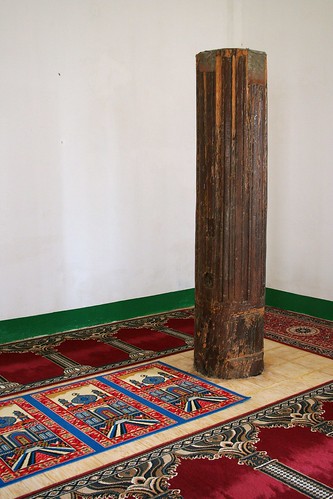
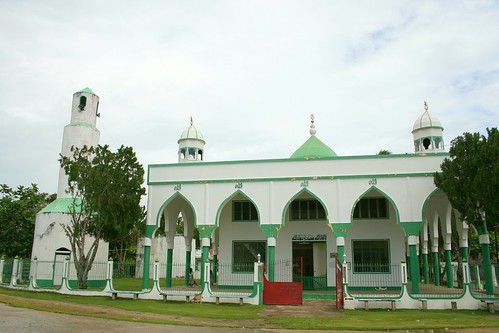

Around 628 hundred years ago, in the small island of Simunul just across Bongao, the capital of Tawi-Tawi, the first Muslim mosque was built by Arabian missionary Sheik Karin UI Makhdum. According to the sarsila (local histories), Sheik Makhdum taught the Sama of Simunul about Islam and impressed them with his supernatural ability of carrying tree trunks from the jungle to the seashore as if they weighed no more than matchsticks.

Today, only four wooden pillars remain of the old mosque. They are displayed inside the Sheik Makhdum mosque that stands where the old mosque once stood, a testament that the spread of Islam in the Philippines started here. Every year on November 6, the Autonomous Region of Muslim Mindanao (ARMM) celebrates the founding of the mosque.

For this year’s Sheik Makhdum mosque anniversary, the local government of Simunul has launched the Ziarah Simunul (Visit Simunul) campaign as a response to the renewed hostilities between the government of the Philippines and the Moro Islamic Liberation Front (MILF). The Ziarah Simunul campaign advocates for the immediate resolution of the conflict through following the example of the Sheik Makhdum mosque where the community gathers to not only pray but also to consult with each other and plan courses of action to promote peace and development.

The two-day celebration on November 6 and 7 will start with a banug-banug pangalay or fluvial parade of Sama bancas or small boats and also feature a kinakan or food festival, and a cultural night of indigenous songs and dances participated by Simunul’s 16 barangays.

Another highlight of the celebration is the launching of development projects, some of which are the result of a participatory and consultative process undertaken to formulate Simunul’s Comprehensive Development Plan-Executive and Legislative Agenda (CDP-ELA) with the help of the Canadian International Development Agency (CIDA) funded Local Governance Support Program in the Autonomous Region of Muslim Mindanao (LGSPA).

Also included in the festivities is the restaging of the Community Big Book reading to highlight the innovative approach to promoting peace and preventing conflict in Simunul. Early this year, the Community Big Book project was supported by LGSPA’s community peace fund, which brought together elders and traditional storytellers to tell their stories. Teachers then documented the stories while schoolchildren made colorful drawings and artwork, which were all compiled into one book and read by the children during community gatherings.

Organized by the local Teachers’ Association, the story-telling sessions revealed the peaceful coexistence that characterized the community in the past and led residents of two disunited barangays in Simunul to rediscover and retrace their roots to the same group of ancestors who had built the foundation of the present-day communities. Through the Community Big Book, residents of Simunul were able to use their memories of past events to promote present day conflict resolution at the village level and strive for harmony in the community.

The Muslim Religious Leaders (MRLs), ‘power centers’ of Muslim society, also play a key role in advocating for peace and good governance in ARMM based on the teaching of Islam. A good example of how they have made a difference in popularizing Islamic values and virtues as core ingredients of good governance will be shown during the Sheik Makhdum mosque anniversary celebration’s community presentation of the Selected Khutba: A Guide to Social Development for the Muslim Communities in the Philippines.

With the help of LGSPA, 2,000 copies were published of the one-year set of Khutba guidelines to be used for the Friday mosque worship homily with the masjid preachers. The creation of these Khutba guidelines on good governance, social justice, peaceful conflict resolution in Islam, and the like, was spearheaded by the five principal muftis of ARMM and finalized after a series of workshops and meetings spanning more than a year. What makes the Selected Khutba such an inspiring endeavor is the fact that it is an expression of more strengthened and concerted efforts of ARMM’s five principal muftis who come from different ethno linguistic backgrounds, to undertake advocacy on the teachings of Islam that significantly promotes peace and good governance.

A highlight of the community presentation of the Selected Khutba is the symbolic turnover of several copies of the English version as well as copies of the 20 khutab of the Selected Khutba’s Sama version to be turned over by Mufti Abdulwahid Inju of Tawi-Tawi to Simunul’s local government officials and MRLS. What makes the community presentation of the Selected Khutba doubly significant is the participation not only of the LGU and the MRLs but also of Parhimpunan Raayat Ma Kasambuhan Tawi-Tawi, Inc. or PARMATA, Tawi-Tawi’s most active civil society organization (CSO).

Composed of 21 member organizations from cooperatives, non-government associations, people’s organizations, and a private sector organization, PARMATA has been actively involved in the development of an Environmental Code that provides the direction for coastal resource management and economic development in coastal areas of Tawi-Tawi. The members of PARMATA have also participated in the last three major elections as volunteers in ensuring clean and honest elections. Both these engagements are part of PARMATA’s three-year action plan for 2008-2010.

During the Sheik Makhdum mosque anniversary celebration, PARMATA will have the significant role of responding to the Selected Khutba’s contents and to subsequently facilitate the drafting of a Call for Peace to be signed by the stakeholders of Simunul. 

At the heart of the Ziarah Simunul campaign is the grand gesture of both Muslim and non-Muslim residents and guests gathering in Sheik Makhdum mosque for the congregational prayer during which the Call for Peace will be reiterated. 

It is not every day that people of all walks of life gather together at the oldest Muslim mosque in a tiny island far south to celebrate peace. The hope is that this most meaningful expression of unity will inspire other similar acts of camaraderie across the country.

Article Continues...

Sunday, October 26, 2008

Debating about corporal punishment

Dropped by Ateneo de Davao yesterday to catch the Masters round of the National Debate Championships (NDC). It's the 'fun' round where senior debaters (mostly former college debaters) are tested for their wit and humor as well as their logic.

The mini-auditorium was packed with English and Tagalog speaking college debaters from all over the country. Girls in shorts, mini skirts, pants, heels, slippers, guys in shorts, slacks, long sleeves, tshirts, sneakers, and so on. Lots of gel and more cleavage than I'm usually used to. Plus lots of loooong legs, funky hairstyles and even one girl with dreadlocks. Nice mixed crowd. My jogging pants fit right in.

I sat a the back and waited for around 30 minutes before the debaters were called up and given their motion: whether or not corporal punishment against children should be disallowed. Four debaters on each side - 'the government' versus 'the opposition.' They were given some 15 minutes to prepare their arguments. Here are some of the things they said:

IN FAVOR OF (+) CORPORAL PUNISHMENT
1. In a liberal democracy, parents bring their children into the world, feed their children, take care of their children, and therefore should also be allowed to decide how to discipline their children.
2. Slapping a child is done not without reason but because the child has done something wrong.
3. Of course, corporal punishment should be used as a last resort - after talking and reasoning
4. If all else fails, there's nothing wrong with spanking obnoxious brats. Slap them to get it over with.

AGAINST (-) CORPORAL PUNISHMENT
1. Corporal punishment should never be an option because abused children become abusers later on.
2. There are other ways to discipline children like talking to them or letting someone else talk to them, corporal punishment should never be the last resort because it can blow out of proportion
3. Parents often spank children at the heat of the moment, to get rid of anger more than to teach a lesson.
4. Inflicting pain causes resentment which helps little in getting the message across.

What I found particularly amusing was how these debaters expertly used the right inflections to emphasize the validity of their arguments and downplay that of their opponents'.
Some debaters though talked really fast and I thought they'd be uh, 'lost in translation' but i was wrong because the audience laughed right on cue. I also noticed that the debaters used 'difficult' words not normally used in ordinary conversation. This might succeed in impressing the judges and intimidating opponents but if you ask me, KISS (keep it short and simple) is still the best way to communicate. Sounding intelligent is nice but the delivery could have been improved. This doesn't necessarily mean speaking slower. Just more relaxed ba. And more poised. (Like Obama. I hope he wins.) Of course with the time constraint, debaters are bound to rush, rush, rush. Their challenge was basically how to make efficient use of the time to say what they want to say in the best possible way.

Kinda like writing an essay. If you're given 1 page to write about corporal punishment and stand out, what points would you include and what would you leave out? What a dilemma this having to make every word count. Especially when you're only given 15 minutes to prepare. Working under that much pressure and coming out sounding the most convincing is something not everyone can do. So congratulations to all you debaters.

I would've loved to stay on and watch the NDC finals that night but I had to go shopping for the trip to Tawi-Tawi next week. Food, earrings, shoes. I'm set. I can't wait to find out who won the debate finals yesterday and what the motion was. Will let you know as soon as I know.

Article Continues...

Saturday, October 25, 2008

Teachers disagree over sex

Last night Bel, Frithjof and I had a massage. Halfway through the session, I started interviewing my masseuse. She's 21, has two kids - 3 years old and 1 year old, and a husband who slaps her once in a while. Me: Is he drunk when he slaps you? She: No, that's just how he is. Whaaaat?! I told her to leave the jerk. She said she can't because she needs him to help out with the kids since she can't do it on her own. Me: Why did you have children so young? She just laughed sheepishly.  


When I got home Pa announced that some professors at the Ateneo de Manila University have stood up to the Catholic Church. You can read the story, "Ateneo profs buck bishops, back birth control bill" in PDI, page A11, Oct. 24,'08. This is basically what the teachers have to say: 

1. Women lack reproductive health care and information on and access to family planning methods of their choice.

2. The rich have few children who are desired and supported whereas the poor are left struggling to feed, educate and take care of their many children.

3. Sex education in the curriculum of public schools will help Filipino youths who engage in unprotected sex.

The dilemma: Church leaders have argued that sex education in schools will encourage young people to try premarital sex. 

The professors' retort: It would certainly be ideal for families and parents to inform their children on sex and sexuality, but this is hardly the case.

My opinion: We need more TEACHERS OF CATHOLIC SCHOOLS who have no qualms about speaking out against the Church's irrational opposition to using contraceptives and teaching sex education in schools.

Bottomline: Let's face it, the Church thrives on the ignorance of women. 

To continue my commentary, I'd like to point out that we live in a country where Catholic schools have always kept mum about sex education because, based on experience, the schools don't "want to rock the boat." This is why I find the story of the Catholic teachers so refreshing which is why last night I started a uh, "text debate" about it with my former colleagues from Ateneo de Davao University. Here's what they said:

Theology titsr: Yu nid consensus 2 teach sex educ in ADDU. Some of us have our own personal stand. Wyl it may be ok 2 speak personaly, bringin d name of d grup, esp pipol wit dissenting opinions, s nt easy. The bill has some positiv n negativ implicatns.

Com Arts titsr: What are the negative implications?

Theology titsr: Depends on whos persepectiv. We hada sessn on that wit a Jesuit moral theologian frm Loyola School of Theology last week. My take is: follow the dictate of your conscience.

Com Arts titsr: What does conscience have to do with sex?! Pipol wil always hav sex. Birth control simply prevents unwantd births - unwanted kc the parents arent ready. They just want sex. Theyr human. Gosh, d church s so m0ralistic.

Psych titsr: Moralistic is an undrstatement. Ancient is a bettr term.

Theology titsr: The church s not agenst sex. its 4 d responsibl use of sex dat it wants 2 promote. Agen, pipol wit diff. view on dis cud always push der argumnt. Everybody s entitld 2 der own opinion man. D bishops hav ders. D others hav. Plurality of voices. Dats wat it shud be. Kaya nga its part of d public discourse.

Com Arts titsr: Hay cgeg discours. Hangtod ra sa discours. These priests and bishops are al talk, quick to condemn if its not NATURAL FAMILY PLANNING. So ur saying d church thinks birth control s iresponsible? Oh cm0n! My opinion is the church as a bunch of males who thnk theyr betr than women, who thnk they hav al d answrs, who nid lotsa money to be christlike. 

Psych titsr: Women shud hold half of d CHURCH's SACRED GROUNDS. Wat shud prevail at the end of d day shud b civil ethics and nt D CHURCH HEGEMONIC DECREES. Amen 2 dat.

Sociology titsr: Kulang ang studnts sa love educ. Akala to love is to open up one's self to be unprotected. Inviting disaster. 

Mass Com titsr: Kay walay maayong sex ed.

Sociology titsr: Meron baya. Pretty good sex ed my girls have. Sage is in grade 5. Lesson nila 2 days ago. Li was quizzing the smaller one at dinner. I cover that in pop and demography when i teach socio 111, pero 2 late by then. Alam na ng freshmen. In soc of d family i deconstruct d constelation pero 10 mil gid ang students ko, kalahati bading. Yati.

Mas Com titsr: LOL!

Sociology titsr:
Anyway, most schooled catholics pay lip svc to d church's stand. They'r likely 2 plan their families. Its the unschooled catholics we shd reach.


Article Continues...

Thursday, October 23, 2008

NOISE


I get crazy sometimes. By the noise at work and at home. Am my ears getting more sensitive I often wonder? Or is it because the world is becoming more crowded? 

The days are getting shorter and the nights longer. I check the clock the moment the sun begins to sink. That's around 5 p.m. By 5:20 p.m. It's dark na and all the street lights are on. The next day, I'm awakened at 5:30 a.m. by loud music about God. Five-thirty! I grumble and try to go back to sleep but the lyrics penetrate my head. I can't listen to my own dreams. Covering my ears doesn't help either. The music is simply too loud - and my room is right next to the neighbors.For a while I tried sleeping early and waking up early to go to the gym. It worked. I felt invigorated. Exercise in the morning and i feel like superwoman. 

But you know, sometimes, a hardworking girl like me who stays in he office often till 8 p.m. or longer, likes to sleep in till 7:30 a.m. It doesn't help if the neighbors are early birds and want the whole neighborhood to wake up with them. Hay naku uy. 

So anyway, one day, when my eyebags were chin deep na, i decided enough is enough. I wrapped myself in a towel against the morning chill and with disheveled hair, went to the neighbors to plead with them not to play loud music until after 8 a.m. For a while, the music stopped. When the music started again, the volume was much softer than before. 

These past days, however, it seems the neighbors have forgotten our deal. So I think that soon, I'm going to send them a Christmas card, thanking them for trying to keep the music low. I'm still thinking about how to write it nicely yet concisely in order to achieve my desired results. Any other suggestions anyone? 

Article Continues...

Tuesday, October 21, 2008

Testimonies from halal consumers

Bai Raga Mustapha is 63 years old and has 11 children. She lives with her husband and youngest son, as well as her sister’s children and their children, in one house in Barangay Solon, Sultan Mastura municipality, Shariff Kabunsuan. The 150 families living in Barangay Solon are related to each other in one way or another; the result of Bai Raga’s father having married and divorced more than 10 times.

During a visit, Bai Raga talked about the difficulty of going to the market and buying food that is halal or permissible by the Holy Qur’an. Fortunately she is able to buy what she needs from the brother of her father’s former tenant who sells poultry and beef which he gets from a respectable Muslim man who has gone on a pilgrimage to Mecca. Bai Raga explains that such a religious man would never sell meat that is not slaughtered in the proper Islamic way.

When she is not at home cooking her food herself, Bai Raga is very careful about where to eat. She does not just eat in any restaurant because she is not sure that the food served is really halal. This is why traveling can be quite burdensome for Muslims like Bai Raga. At least when she is in Cotabato City on an errand, she knows where to go to eat. There is a carinderia or a small side-walk restaurant owned by a Muslim, who Bai Raga is assured, only cooks halal food.

Weddings are another problem because, although no pork is served, Bai Raga feels she cannot be 100% sure that the ingredients used in cooking do not have any pork by-products in them. So to be on the safe side, Bai Raga does not eat during weddings. There was even a period of two years when Bai Raga stopped eating bread because a visiting ustadz had informed her that the non-Muslim bakers in Manila bake cream bread pandesal using margarine or lard made of pork by-products. This made her suspicious of all bakeries and she has since then refused to eat any kind of bread.

Like Bai Raga, Ustadz Ebrahim Buisan, a faith healter and Islamic teacher, is not sure what to think of all the products available in the market. Are they halal or not? This has always been the dilemma of Muslims who look for halal food, but because most of the food has not been certified halal, they end up buying canned goods like beans and sardines, which they assume are halal simply because there is no pork in them.

Not surprisingly, when in 2007 Tam’s Bakery became the first business establishment to have its bread certified halal by the Muslim Mindanao Halal Certification Board, Inc. (MMHCBI), Bai Raga, Ustadz Ebrahim, and other Muslims, started patronizing the bakery for its halal bread and pastries. In those early months, the bread in Tam’s Bakery would be sold out by four o’clock in the afternoon. It apparently did not matter that the owner was a non-Muslim.

Soon, other entrepreneurs followed suit in applying for halal certification. They persevered for months in gathering all the requirements before finally being able to meet the standards set by MMHCBI. As of September 2008, around five (5) business establishments have been certified halal by MMHCBI and eight (8) others are on the waiting list.

Through word of mouth and with the help of DXMY’s popular weekly radio program, Suara na Talained (Voice of Mindanao), Muslim communities as far as Davao del Sur, Tawi-Tawi, Basilan, Jolo and Zamboanga are kept abreast about what business establishments have been certified halal by the MMHCBI. Apart from this, the show gives the public tips on how to set up their own halal business, and helps them distinguish between halal and haram.


For Akmad G. Donia, one of the anchors of Suara na Talained, Muslim consumers should question what they eat. He says, “We should aim for excellence and never be quick to say, ‘this is okay’ just because there is nothing else.” The Philippine Halal Consumer Watch (PhilHalal), which Akmad is the president of, is a group of concerned consumers who formed the organization to do just that. PhilHalal has already made inquiries with manufacturers of Clusivol and Ajinomoto about whether the ingredients used in the products are halal. It has been more than a month yet no response has been received which is why PhilHalal is not recommending the purchase of these products. “In case of doubt, avoid it,” Akmad reasons.

Aside from directly confronting manufacturers, another of PhilHalal’s major activities is visiting schools and other venues to inform Muslim audiences that halal is more than not eating pork. It also involves meeting the international hygiene and sanitation standards of Hazard Analysis and Critical Control Points (HACCP), Standard Sanitation Operating Procedures (SSOP), Good Manufacturing Practices (GMP), and Organization for International Standardization (ISO). Akmad never fails to point out to consumers their important role in the development of the Philippine halal food industry. “You have to drive the demand for halal,” Akmad tells them.

As brand new as it is, PhilHalal has big plans like expanding membership to include non-government organizations (NGOs) in order to make PhilHalal a force to reckon with. Other priorities are to promote halal in socio-economic reconstruction development plan in conflict-affected areas, and to lobby for policy support. Needless to say, PhilHalal is very supportive of all halal certifying bodies but especially of MMHCBI because it is based in ARMM and therefore is the easiest to contact.

A day will come when Muslims in the Philippines will not anymore have to buy products from Thailand and Malaysia which have been certified halal there. Akmad points out, “This stop-gap solution to the halal demand in the Philippines only succeeds in making us Muslims more dependent on what foreign countries have to offer. Let’s instead patronize our own halal products!”

Article Continues...

Friday, October 17, 2008

Emerald Durian Palace

Note: Went to Cotabato City for 5 days and interviewed 10 people. Actually 12. One I interviewed in Davao and the other one I interviewed over the phone. This here below is a result of the interview I had over the phone.

In Tagum City, there are about 1,032 hectares planted with durian trees. Famers are motivated to grow durian through a city government scheme that offers them seeds, fertilizers and trainings in how to start their own durian farms. Only during the fourth year when the first durian fruits are harvested, does the government collect 30% of the costs of the inputs which the farmer availed of.

Alma Uy, whose family has been cultivating durian in some 50 hectares of land in Tagum City since 1995, does not regard these other durian farmers as competition. In fact, Alma has always been eager to help out and buy the surplus of others in order to use as main ingredient for her growing business: Emerald Durian Palace. In this 40 feet wide and 64 feet long durian processing plant, some 10 workers create more than 20 different kinds of durian-filled delicacies such as durian buns, durian loafs, Brazo de Mercedes with durian filling, durian cake, durian blondies, durian cashew bars, etc.

The durian jam, in particular, has become one of Emerald Durian Palace’s most sought-after products especially during the month of Ramadan because the carbohydrate-rich durian is an excellent source of energy for fasting Muslims. Alma proudly explains that Emerald Durian Palace’s brand of durian jam contains no extenders such as flour; only durian, sugar and milk are used which give the jam its authentic durian taste.

How Alma managed to build this small durian empire over time is an interesting story. In those early years when the Uy family’s durian farm was still new, its 7,000 hybrid durian trees from Malaysia and Thailand produced more durian than could be sold in time. Faced with low market prices because supply exceeded consumer demand, Alma decided to venture into durian processing – beginning with durian pastillas.

In her search for the perfect recipe, she found someone to teach her and eventually bought the recipe for 20,000 pesos while continuing to experiment with other concoctions. Today, Alma has expanded her durian delicacies from pastillas to cookies, tarts, polvoron, pies, hopia, and so on. These are now being sold in department stores and outlets in Tagum City, Davao City, Cebu City, Zamboanga City, and Cotabato City.

Business has been so good that Alma has set her sights on franchising and exporting. The much-needed boost arrived in November 2007 when the Department of Science and Technology (DOST) invited her to join a seminar on how to get halal accreditation for her products. Realizing that this was a chance to possibly export her successful durian jam to Muslims living abroad, Alma did what the Muslim Mindanao Halal Certification Board, Inc. asked her to do. She hired two Muslim employees, provided all employees with uniforms, bought better food processing equipment, covered all the wooden rolling pins with stainless sheets, put a screen over the oven, renovated the restrooms, and bought ingredients from suppliers which had been certified halal.

Several months later, on July 1, 2008, the durian jam of Emerald Durian Palace was certified halal by the MMHCBI who also offered to help distribute the product to other Muslim-dominated areas in Mindanao. In no time, sales doubled, especially in Cotabato City area where the armed conflict has not managed to halt transportation. Alma, nevertheless, remains invigorated by the MMHCBI’s support and is bent on having one product certified halal every two months.

Article Continues...

Tam's Bakery

Note: This story I wrote based on the interview with Tony Chi, the owner of Tam's Bakery. It's interesting how his family stayed in Cotabato City and persevered in their business even when many other Chinese gave up and left. As a result, Tam's Bakery is Cotabato City's oldest bakery today. 


The late Chi Tham was born in Guangzhow, China but moved to the Philippines to work as an apprentice with Victoria Biskit Company. The stint with the cookie factory eventually motivated him to put up his own bakery in Cotabato City on October 6, 1946. He aptly named it Tam’s Bakery, after himself.

Sixty-two years have passed since then. Son Tony Chi, a Christian, continues running the family business in a predominantly Muslim community. Understandably his Muslim clients, Tony says, prefer that the pastries and bread they buy do not contain any pork fat. This is why when the Muslim Mindanao Halal Certification Board, Inc. (MMHCBI) sent a letter in 2007 inviting Tam’s Bakery to get certified halal, Tony immediately complied. This was his chance to erase the doubts of his Muslim customers that the ingredients used by Tam’s Bakery are halal and permissible by the Holy Qu’ran and by food technologists.

Tony wasted no time giving MMHCBI all the government permits that it asked for as well as a list of all the ingredients used by Tam’s Bakery. This was how Tony discovered that the halal dough improver, the dough conditioner and the dough emulsifier – products of Malaysia – were already certified halal. Other ingredients which were not halal because they contained alcohol, for instance, were either removed or replaced with non-alcoholic ingredients. Upon the recommendation of the MMHCBI, a new stainless steel bakery table was made to replace the plastic bakery table. Another major improvement was the hiring of Muslim employees. Several months later, on September 12, 2007 Tam’s Bakery became the first business establishment to be certified halal by MMHCBI.

A direct result of being certified halal by the MMHCBI is today’s 15% increase in sales. Tony says that Muslim clients, who before did not buy at the bakery due to doubts that a non-Muslim is able to bake halal bread, have had a change of heart. Because of this renewed demand for bread and pastries by Muslim clients, some 15 bags of flour each weighing 25 kilos are used up daily by Tam’s Bakery. Business is so good that Tony did not have second thoughts about applying for another year of halal certification. He explains that it would be a pity if he would not renew halal certification now that Tam’s Bakery has painstakingly met all of MMHCBI’s requirements.

Already Tony is eyeing to move Tam’s Bakery to a bigger building where production volume can easily be increased to 100 bags of flour a day. The possibilities seem so promising that Tony aims to put up similar bakeries in other areas of Mindanao when the time is right.

Article Continues...